
Pour la version française de cet article, sélectionnez Le Jardin Botanique de Montréal.
I dream of color, greenery, flowers and warmth. I head to the Montreal Botanical Garden, known for its importance among the most beautiful gardens in the world. Since I bought my Passeport Espace pour la vie (Space for Life passport) in early September, I can book my ticket at no extra cost to visit the greenhouses. I think that’s the best investment I have made allowing me unlimited year round access to the five Montreal attractions members of Espace pour la vie. My passport was paid for in less than three visits.
I had selected the 10:30 visit because a volunteer guide was leading the tour. I arrived a few minutes early, the parking lot at the entrance was almost deserted. The cost of parking is $12.75. When I entered the main pavilion, I put my coat in the dressing room in a locker for $2 and was ready for my adventure. Your ticket allows you to spend as much time as you want at the Botanical Garden during the day. You can arrive in the morning, go out to eat and come back with the same ticket for the rest of the afternoon.
Another person, who had already led visits, joined me and we went to explore the nine greenhouses open to the public that day. Only the Main Exhibition Greenhouse was not accessible. About the Botanical Garden here is what I gathered on the website:
The exhibition greenhouses, opened in 1958, they cover an area of 4000 m2. The 36,000 plants they contain represent 12,000 species, varieties and cultivars.
Source : Botanical Garden’s website
The Molson Greenhouse
Named in honour of one of Montreal’s great philanthropic families, it is the Hospitality greenhouse of this living museum. Several explanatory panels inform neophytes about botany, nutrition, reproduction and plant protection.
The plants on display in this greenhouse are large, monocotyledon plants. This term refers to a set of plants that are derived from a seed and whose only leaf comes out at the same time hence the prefix MONO, the set of these superimposed leaves will form the body of the plant that will not turn into a trunk with a bark. These plants will produce very symmetrical flowers most often of the trimery type, the prefix TRI refers to the number three, therefore 3 sepals, 3 petals, 2 times 3 stamens and 3 carpels. The leaves are often long. Among the plants of this group we can mention palm trees, banana trees, grasses, reeds, and orchids. However, we will see the orchids later, a complete greenhouse is dedicated to them.
We can also notice some display cases containing insectivorous plants. In some cases, the flowers look like large elongated calyxes with a narrower colored rim. The narrower edge prevents water from accumulating in the flower. The color attracts the insect, which enters the calyx and goes down to drink the nectar. Unfortunately small hairs or small asperities point downwards and it is time to start ascending the insect is trapped. Gradually the liquid at the bottom of the flower will dissolve the insect and the plant will be able to assimilate it. In other cases, the plant secretes a sticky liquid that will prevent the insect from flying off once it lands on the plant. These are just two types of traps that insectivorous plants use, other types of traps also exist.
We were also able to see two examples of plant wall. The plants are inserted in small pockets and an irrigation system ensures the watering and distribution of nutrients necessary for their growth.


The begoniaceae and gesneriaceae greenhouse
This greenhouse is dedicated to begonias and African violets. These are two plants that need light but not an extended number of hours of direct sun exposure. So curtains have been installed to diffuse the light in the greenhouse on days of full sun. These two families of plants are very often found in tropical areas. The greenhouse climate is adapted according to the needs of these plants, so it is hot and very humid.
When we observe a begonia, we notice that all begonia leaves, regardless of species, are asymmetrical in shape. The size of the leaves, their shape, and their color are also very diverse. In some cases, we notice lighter spots, it is to attract more light on the plant to help the photosynthesis phenomenon. You can see an example in one of my photos at the end of this section.
In addition, some species have male and female flowers. How to recognize them? The male flower is very simple, composed of a few petals. The female flower is more ornate, it has the same petals but you will also notice sub-petals that are often perpendicular to the upper petals. Other species have a type of hermaphrodite flower. The flower has both the male and the female organ so it can self-pollinate or with the help of insects have a cross pollination when the pollen attached to the body and legs of the insect is deposited on the female organ of the flower when it lands or walk on that part of the flower.
Begonias plants have several shapes and sizes. In Quebec, we all know about annual plants, but in countries with an appropriate climate, we can find climbing plants, shrubs, perennials or epiphytes. Epiphytes are plants that only need a support, either a rocky outcrop or a tree branch. The roots cling to it and remain in the open air, absorbing water and moisture necessary for the growth of the plant.
We also saw some specimens of African violets, but we mainly talked about begonias.


Arid Regions Greenhouse
We are leaving the tropical climate for a desert climate. What a contrast. The plants exhibited in this greenhouse come from two different continents, Africa and America. Do you know why plants in arid regions very often have thorns or needles? This is to help collect a maximum of water contained in the humidity of the air, or dew in early morning or when there are fog episodes. During the day the temperature is hot, at night the temperature can drop by several degrees up to tens of degrees.
In Africa, we notice a great variety of succulent plants. These are plants that have very thick leaves that fill with water to preserve the nutrients needed for the plant. Among other things, on that continent we will find aloe vera. In America it is mainly cacti and agave. Agave is the plant used to make tequila. It is a plant that produces only one flower in its life. When the flower fades, the plant dies.
The guide mentioned that the Botanical Garden had an agave plant that was almost 100 years old. At one point she developed a floral pole that reached the ceiling of the greenhouse, the glass above the plant was removed as the phenomenon occurred in summer. The flower pole grew to almost 2 meters above the greenhouse roof. Unfortunately, in November, the flower was cut in order to close the window since the cold was harming the other plants in the greenhouse. The agave died, it was eventually replaced by another one.


Hacienda
The Botanical Garden wanted to recreate an ornamental garden that we find in the inner courtyards of the Mexican haciendas. The climate and soil do not allow the cultivation of grass. In this way, grasses and cacti with a variety of shapes and colours make it possible to create beautiful gardens on a background of sand and gravel.


You will notice that on the leaves of some plants, we distinguish memory growth. Like a layer of bigger and bigger sheets as the leaf grows.

The Penjing Greenhouse
Contrary to popular belief, the Japanese were not the first to grow potted trees. The Chinese are the instigators of this art, the Penjing, under the Han dynasty around 200 BC. The Japanese shaped the first bonsai rather around the 6th or 7th century.
Penjing are trees kept in small pots with very little soil. The root system is regularly maintained to prevent excessive expansion. To achieve a form more pleasant to the eye, the sculptor can bend a branch with small cables applying a constant pressure until the desired result is obtained. The trees follow the rhythm of life of a normal tree with periods of dormancy in winter. Many sculptors can work successively on the same tree because of its lifespan, which can easily reach more than a hundred years. At the time of our visit, the temperature was close to freezing and some windows were ajar. Since the tree is dormant, you won’t see a tree with leaves on the photos except for the conifers, but you can appreciate the silhouette of these miniature works of art.


The other features of this greenhouse were also beautiful with mosses and creeping plants lining the beautiful water garden. The climbing shrub rose that you see on the wall, will bloom shortly given the very large number of buds present on the plant. A few yellow roses were already in bloom. There were also bamboos. The guide mentioned that the inside of the bamboo stem is empty, which is why a bamboo can grow faster without having to spend as much energy as other plant to fill the entire cavity of its stem.


Tropical Rainforest Greenhouse
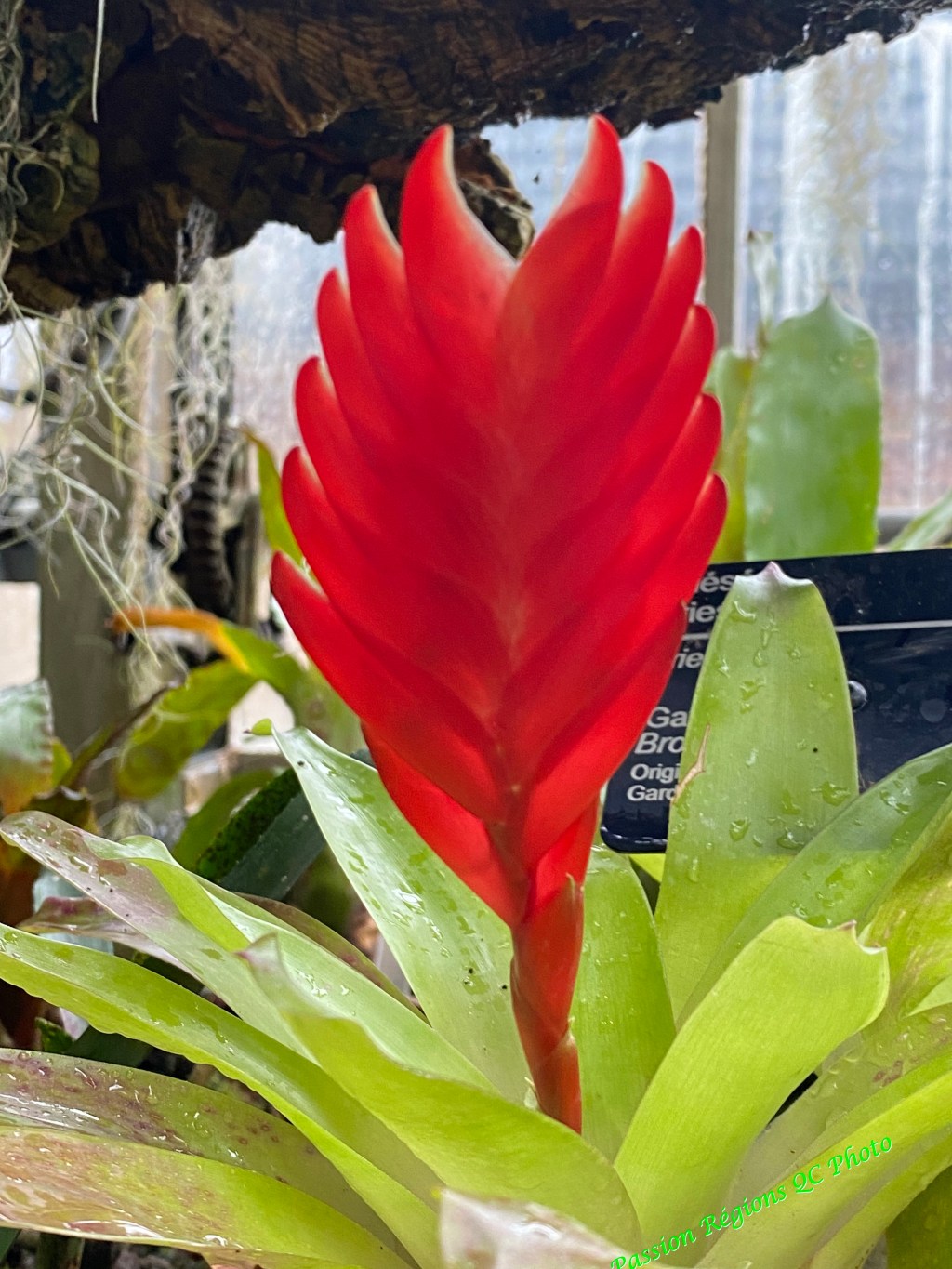
The Botanical Garden wanted to reproduce in this greenhouse the section of the canopy, the section at the top of the trees that benefits from more light. It is the most colorful part with a multitude of plants and flowers that compete fiercely to attract light, insects and birds. On the ground, we find examples of plants that proliferate at the foot of trees. To imitate the canopy, metallic structures covered with cork emulates the trees on which the epiphytic plants hang (which we saw above in the begonia section). We notice several species of bromeliads whose interlinked leaves allow water to accumulate in the center, creating a micro system that is beneficial for both insects and the plant.


Tropical Food Plants Greenhouse
A greenhouse where I could have spent the day. I love to cook and have owned restaurants. Imagine my happiness to contemplate exotic fruits and spices elsewhere than in a pot or on a grocery shelf. I saw bananas, clementines, a cocoa pod, a jack fruit, papayas, pepper on the cob, star fruit, cherry coffee beans. You read right, the fruit of the coffee tree is called a cherry. What is remarkable about this fruit is that they do not all mature at the same time, so it is possible to extend the harvest over several months.
I would have appreciated a tasting workshop when visiting this greenhouse! The guide mentioned that all crops are given to a community organization.
Another thing I learned, vanilla is the fruit of an orchid. When the first explorers discovered this exotic spice, they wanted to plant it in all the regions they had colonized with a similar climate, but without success. The vanilla tree flowered but did not produce fruit. You will understand why in the next greenhouse, when I will tell you about the orchids.


Orchids and Aroids Greenhouse
WOW!!! Impossible to decide for my favorite, they are all so beautiful.
What I have learned about them is that each species of orchid has its own insect to ensure its pollination. So if you move an orchid to a new territory, it will no longer have its particular insect, then it can no longer be pollinated. Now you understand why vanilla pods didn’t grow when I told you about this story in the tropical fruit greenhouse. By transplanting them in other countries, the insect was not present in the new environment, the flower faded without producing fruit, so no vanilla bean.
Fortunately, humans have learned to manually pollinate plants. So women, who in some areas do manual pollination of orchids are called matchmakers!
Do you know why all the orchids in the Botanical Garden are in bloom when we visit the greenhouse? For each of the greenhouses I have listed since the beginning of this article, you must count three more production and care greenhouses (so 3 x 10 = 30 more greenhouses closed to the public). So when a specimen is in bloom in the production area, it can then be transferred to the greenhouse open to the public.


Ferns Greenhouse
Ferns appeared on earth BEFORE dinosaurs and flowering plants. Ferns are found in many places on our beautiful planet if the conditions are right for them. We have them in Quebec as well as in tropical and subtropical regions. What distinguishes ferns from other plants is that they have no flowers or fruits. They reproduce through spores located under their leaves. Lift up a fern leaf and you will notice below it, depending on the species, either points or lines or brownish spots. These are the spores. So they can come off the leaf and fall to the ground or else when the leaf tilts and touches the ground, the spores end up in the ground and can allow new ferns to grow.
You probably know that fiddle heads are actually fern leaves in formation. Ferns can grow to very large sizes. You will notice in one of the photos a violin head, which was as tall as me. I had to stretch my arms up to try to take the picture.


The End…
This concludes my guided tour with Michèle. It took us 90 minutes to walk through the 9 greenhouses. I suggest you opt for the guided tour, it is so much more rewarding than walking alone to look at plants without knowing too much about them, what they are, and what are their peculiarities. There is no additional fee for a volunteer guide once you purchase your entry ticket. Guided tours are offered twice daily, one in the morning at 10:30 am and the second one in the early afternoon at 1:30 pm.
I also had a look at the Botanical Garden shop, there are beautiful gift suggestions or objects for gardening, decoration, learning tools for both young and old, books, games and plush vegetables and plants.
The Botanical Garden offers dining areas only during the summer. Visit the restaurant page of the website to see the opening dates and times of the restaurant, the café-terrasse and the crèmerie.
4101 Sherbrooke Street East
Montreal QC H1X 2B2
Canada
Telephone
+1 (514) 868-3000
Toll Free
+1 (855) 518-4506
Latest posts.
Restaurant recommendations in Siena
Here are some of my recommendations on where to eat in Siena as well as a few places to discover if you are a foodie.


The Ice Hotel in Quebec City
For a stay giving you chills of pleasure, select the Ice Hotel in Quebec City.
Un site WordPress.com.
 Passion for Québec and Elsewhere
Leave a comment